
Acting out Dreams during REM Sleep
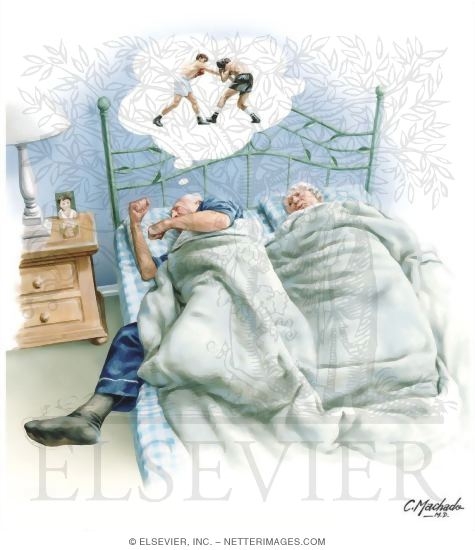
It was 3am, Summer; a slight breeze entered the bedroom in gentle puffs cooling down the warm air. Sonia slept soundly, as did her husband of forty years, Michael. Sonia awoke slowly to sounds next to her and realized Michael was mumbling in his sleep. His body and hands twitched slightly and she sleepily thought, “Oh, Michael’s having a dream.”
Suddenly, Michael kicked Sonia in the middle of her back with his full force. This was immediately followed by a second kick accompanied by loud shouts. She realized that he was preparing to kick again and flew out of bed. Fear gripped her as she looked at her husband’s violent movements. He was now inching towards her in their bed – still kicking – still fast asleep. Hoarse with fear Sonia screamed, “Wake up, wake up, wake up!” And then her screams seemed to get through to him. Michael became conscious and stopped kicking. He remembered his dream; intruders had come into their house and were ascending the stairs. In his dream he was kicking at them to knock them down the stairs. But he had no recollection that he had acted out – kicking Sonia fiercely, leaving her with a sore back for a day. Both feeling shocked, they went to sleep again thinking this was a one-off incident.
But it happened again and again; once or twice week. Sometimes Michael would punch Sonia; sometimes he’d sit up in bed with his arms flying around, hitting her. Her fear of injury led her to start waking up at the slightest sound or movement so that her sleep became disturbed most nights. Sonia began shouting to wake Michael up as soon as he started mumbling or twitching – before Michel’s dream got to the point of hitting or kicking.
What neither Michael nor Sonia knew then was that Michael was suffering from a rare form of sleep disorder called REM Sleep Behaviour Disorder (RBD). This disorder results in the person acting out their dreams instead of lying still as one usually does.
What Is Rapid Eye Movement Sleep Behaviour Disorder (RBD)
It is a sleep disorder (a parasomnia) that involves acting out behaviour during the sleep phase characterised by Rapid Eye Movement (REM sleep). The person experiences vivid dreams which are generally frightening and which usually involve attacking or chasing. The acting out behaviour mirrors the content of the dreams. RBD is not a psychiatric disorder but a medical problem.
Normally, the brain inhibits skeletal muscle movement during REM sleep so that despite experiencing vivid dreams, the muscle paralysis inhibits motor movement. But RBD is characterized by loss of normal muscle atonia (paralysis) during REM sleep. The result is that the dreaming person can display a variety of acting out behaviours during sleep – from twitches and mumbling to violent kicking, punching, screaming, grabbing and diving out of bed. This behaviour can injure the dreamer or their partner in bed. People with RBD have been known to dive out of their windows while dreaming they are chasing someone or, being chased.
RBD is not the same as sleep walking, talking or night terrors which take place during the phase of deep sleep, as opposed to the stage of REM sleep. Dreamers tend to wake up confused by physical activities experienced during deep sleep but are immediately conscious when woken up from a RBD episode of dreaming during REM sleep.
Normal Sleep Cycle
The normal sleep cycles passes through several stages several times a night so that we experience REM sleep up to four times a night. This means that some people with RBD may experience episodes four times a night while with others it may only happen once a week or once a month.

Causes
RBD can be caused by reactions to certain drugs or during drug withdrawal or alcohol withdrawal. It is also linked to stress. It has also been reported after strokes and is linked to tumours, including brain stem tumours and sleep deprivation. RBD is also found in association with Parkinson’s disease, dementia, multisystem atrophy and often precedes the onset of neurodegenerative disease. Some antidepressants can induce or aggravate RBD symptoms. Other sleep disorders may be related to RBD such as sleep apnea (abnormal pauses in breathing or instances of abnormally low breathing during sleep). RBD often precedes the development of neurodegenerative diseases such as Parkinson’s and Lewy body dementia by several years although not all people with RBD develop Parkinson’s.
Who Gets It
RBD is found most often in men. It may appear at any age but usually emerges at about 60 years of age and more often in the elderly. Less than 1% of people have it.
Treatment
RBD can get worse over time which can put the person or their bed partner in danger. It is also often linked to other medical problems. Because RBD can be confused with other conditions it is important to see a doctor if you suspect you may have it so that the actual medical condition can be established. Medical sources cite various treatments and note that a combination of counselling and pharmacology usually proves effective.
“Sleepwalk With Me” – A film by Mike Birbiglia on RBD
This film is not a documentary but it is based on real events in Birbiglia’s life. Birbiglia, the lead actor and director of the film was diagnosed with REM behaviour disorder. A stand-up comedian in real life, Birbiglia based much of the material used in gigs on his acted out dream episodes before writing a book and making the film on his condition and experiences.

Read more about this film by clicking on the link below:
http://edition.cnn.com/2012/10/02/health/sleepwalking-rem-behavior-disorder/index.html
See a small clip from this film on YouTube:
Could Dream Analysis play a Role in this Medical Condition

It has been documented and is known that medical conditions have an effect on dreams and their content. For this reason, as a psychotherapist, one requests that a client visit a doctor to rule out a medical condition in the case of certain dreams which seem to point to physical illness.
But dream analysis also maintains that whatever dream the psyche produces, it has relevance for the dreamer. From this perspective, even though the dreams associated with RBD are often frightening and usually entail attacks and being chased, they will probably differ according to the specific person’s life experiences, complexes, strengths and weaknesses.
This suggests that it could be beneficial for a person suffering these dreams to work with them from the perspective of identifying in which way they may parallel conscious circumstances of helplessness, lack of assertiveness and so on in everyday life. This in itself could mediate and improve the person’s quality of life during the period before a neurodegenerative illness advances excessively. But in instances of RBD linked to stress or drugs, analysis of the dream content could lead to improved and empowered quality of life in the person’s future.
Further reading on REM Sleeping Disorder
http://phys.org/news190056333.html
http://www.webmd.com/sleep-disorders/guide/rem-sleep-behavior-disorder
http://yoursleep.aasmnet.org/disorder.aspx?id=29
www.ncbi.nlm.nih.gov./pmc/articles/PMC2902006/
 Leslie Zimmermann is a Jungian Analyst trained in the philosophy and psychology of C.G. Jung in Zurich and is based in Johannesburg. She offers a range of services, which she integrates, to meet the needs and aspirations of people. In a word, her work is in the service of wholeness. Wholeness includes both our vulnerabilities and our strengths, becoming conscious of our own unique mix of these, honoring our own unique way of functioning and with this knowledge and confidence, contributing as only we each can in our own way, to this evolving world we find ourselves to be a part of.
Besides having a Diplomate qualification in Analytical psychology, which qualifies me to write about the theory and practice of dream interpretation, I also have an Honours degree in Applied Psychology and a Masters degree in Research psychology, which qualify me to write about theories of human development, personality, abnormal psychology, social psychology, sociology and ethics. Also, theories and knowledge pertaining to sleep and dreams from a perspective of neuropsychological and biological systems.
Leslie specializes in Analytical Psychology, Voice Dialogue, Life Coaching solutions for business executives. Consulting and coaching for family owned and home-based business
For an appointment Leslie Zimmermann can be contacted on:
Email: leslie.zimmermann@gmail.com
Mobile: +27 (0)83 384 9812
Member: SAPC (South African Psychoanalytic Confederation); AGAP (Association of Graduate Analytical Psychologists, Switzerland); SAAJA (Southern African Association of Jungian Analysts); IAAP (International Association for Analytical Psychology)